

Writing Slant
Flash fiction, feeling, and form with WestWord Prize judge Kathryn Aldridge-Morris


Hi Story Lovers,
I'm delighted to share this conversation with Kathryn Aldridge-Morris today. She’s a flash fiction writer whose work consistently does what the very best flash does — stays with you long after you've finished reading.
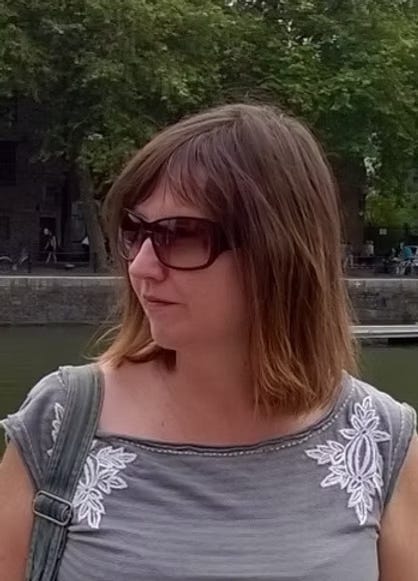
Kathryn is judging this year's WestWord Prize, and I wanted to give our readers a glimpse into her creative mind before she sits with the shortlist. What strikes me most in her answers is something I find myself returning to in my own writing and teaching and publishing here at WestWord: that the stories which resonate most are the ones written from a place of genuine vulnerability.
I hope this conversation inspires you as much as it did me — and if you haven't yet entered the WestWord Prize, I hope it sends you straight to your desk to get polishing your draft. There are £750 in prizes available for the three winning stories.
With love,
Amanda 💙
Kathryn, you’ve mastered that delicate balance between economy and emotion in flash fiction. Can you talk about a specific moment when you realised a story needed less and you discovered the power of what you weren’t saying?
One specific instance is with my story ‘Riptide’ which was Highly Commended in the Bath Flash Fiction Award in 2022. This started out at around 800 words and I could feel it wasn’t working, that there wasn’t the urgency or energy which I think fuels the best flash. I was writing from an emotional place I’d experienced, a feeling of powerlessness, drowning, and weird dissociation that comes with trauma, but felt the form was flattening the emotional core of the story. It started out as a hybrid set of instructions - How to Survive Drowning - with the story interwoven. I started cutting back and cutting back, to try to reach the emotional core, and the instructional paragraphs started to reappear as phrases within a breathless paragraph, rather than as distinct paragraphs. I didn’t want any white space for the reader to come up for air – this was a drowning story after all. So rather than being an overt metaphor, the sense of drowning gradually came to be revealed through fragments of instructions, working to slowly build the emotional resonance.
The Bath Flash Fiction Award, The Forge, QuietManDave Prize — your work has resonated with diverse judges. What do you think these award-winning pieces share in their DNA, beyond technical skill?
I like the idea that every writer’s body of work has its own DNA! And I think the answer for me will hold true for all other writers: writing about experiences which are singular and unique to us (or those we can imagine, identify and empathise with), but which hold universal resonance. We all go through many of the same life events, but it’s about seeking out the specific details which render them unique. Finding a way to write about a universal truth slant, whether that’s by experimenting with form, or writing in elements inspired by unusual events, settings or details. My aim is to achieve that balance of surprise and resonance.
You’re known for trusting readers to feel their way to the truth rather than spelling everything out. How did you develop this confidence in white space and subtext? Was there a turning point in your writing journey?
Possibly discovering the 100-word micro where I learned how to fine-tune the craft of selecting words freighted with connotation and subtext. Micros also helped me to really grasp how to set up a story which could continue beyond the final full stop. Once I nailed this, I understood how white space could carry a story between paragraphs, and how to convey subtext in the most minimalist way, and this was central to developing my style in longer flash.
You’ve been published in many wonderful journals—Pithead Chapel, Fractured Lit, Bending Genres. How has being part of the flash fiction community shaped your understanding of what this form can do?
I think the flash fiction community is one of the most vibrant and generous parts of the literary ecosystem right now. It’s an ongoing process of shaping my understanding as flash fiction seems to be constantly evolving – and this is why I love it! I’m constantly in awe of how writers are finding ways to evolve the form, as well as creating stunning sentence-level art and challenging how stories can be told.
Your Wigleaf Top 50 selections are such an honour. Looking back at those pieces now, what do they teach you about your own artistic instincts?
Yes, it was truly such an honour to have those pieces selected – and I’m grateful also to the editors who took them in the first place for publication. I suppose it tells me to continue writing the stories that matter to me, otherwise they won’t matter to the reader. They were both pieces which emerged from a small detail or incident which kept resurfacing from my subconsciousness, nudging me to write about them. I always start with images and memories which hold strong emotions and take the story from there.
Sensory detail seems central to how you create emotional resonance without explanation. Can you walk us through your revision process — how you identify where a story needs a concrete image versus a more abstract moment?
The kind of questions I’ll ask myself during revision are: Does the setting and do the objects work hard enough to convey the overall tone? If not, I’ll hone in on the details, perhaps switching out an image for something more startling or finding a way to describe it which is more tonally resonant. If there has been a passage of internal thought or reflective commentary, I might seek to balance it with some movement in the external world of the story and that will require adding in those concrete images.
You’ll be reading the shortlist of ten stories for this year’s WestWord Prize. What do you imagine will help you spot the winner? What’s that intangible quality that elevates a technically sound piece into something unforgettable for you?
I think as readers we can intuitively sense authenticity on the page as much as in people. When we write something that matters to us, we make ourselves vulnerable. Even fiction betrays the themes which preoccupy us. So, for me an unforgettable story will not only have that stand-out, unique metaphor or image, but it will manage to be vulnerable while at the same time being confidently told.
Thanks so much for your wonderful insights, Kathryn. Do let us know in the comments what you think about Kathryn’s process and ideas.
The WestWord Prize closes for submissions on 31st March 2026. Get all the info here.
This was so helpful as I try to find ways to improve my writing. Thanks Amanda (and Kathryn) for sharing it.